OUR STORY SINCE 2007
Our History
From five blocks and sixteen staff to a hospital serving the whole of the South East. This is how St Joseph’s Eye Hospital Mgbirichi came to be, and how it grew.
How it began
Construction of the hospital started on the 14th of February 2007.
It was officially opened almost three years later, on the 29th of December 2009. The hospital did not open with a ceremony alone. It opened by working: free eye treatment was offered from that first day, and more than 350 patients were treated before the opening was over.
That decision set the character of the place. A hospital that begins by treating 350 people who could not otherwise have been treated has said something about what it is for, and it has been saying the same thing ever since.
A hospital of the Daughters of Mary Mother of Mercy
St Joseph’s Eye Hospital is owned and managed by the Congregation of the Daughters of Mary Mother of Mercy, and it remains a mission hospital in the full sense of the word.
That ownership is not a detail of paperwork. It is the reason the hospital sits where it sits, in a rural local government area rather than a city centre, and it is the reason free and subsidised treatment, community eye camps and school screening have been part of the work from the beginning rather than added to it later. The Sisters who founded the hospital continue to serve in it, as consultant ophthalmologists, as resident ophthalmologists, and in its administration.
What we started with
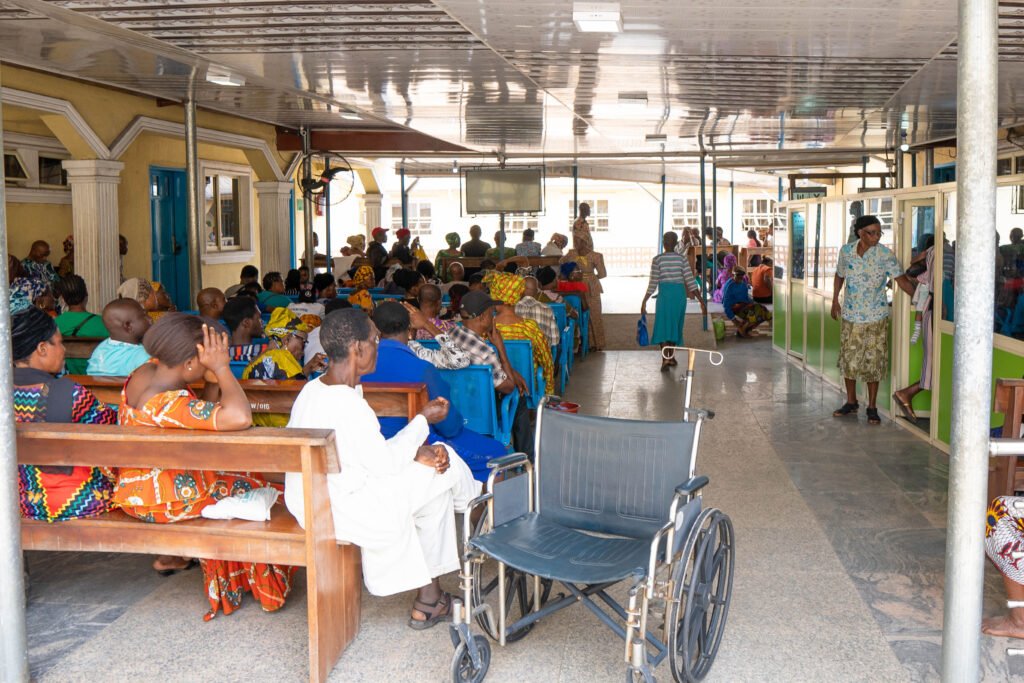
In 2009 the whole hospital consisted of five buildings:
- An outpatient department block
- A ward with 32 beds
- A theatre block
- A kitchen block
- A generator house
And it was run by sixteen people:
- One ophthalmologist
- One optometrist
- Two ophthalmic nurses
- Two community health workers
- One optician
- One bursar
- One driver
- Three janitors
- One storekeeper
- One maintenance technician
- Two security staff
It is worth naming them by role rather than summarising them, because that list was the whole hospital. One ophthalmologist carried every surgical case. Two nurses covered a thirty-two bed ward. Everything built since has been built on top of those sixteen people.
HOW FAR WE HAVE COME
From 2009 to today
The original ward has more than doubled, allowing us to admit for surgery in numbers that were not possible at opening.
Sixteen people ran the entire hospital in 2009. Around seventy do so now, across clinical, optical, technical and support roles.
Two consultant ophthalmologists are now in residence, where the hospital opened with a single ophthalmologist covering everything.
A visiting paediatric consultant ophthalmologist, a visiting vitreo-retinal consultant ophthalmologist and a visiting anaesthetic consultant.
What began as an OPD, a ward, a theatre, a kitchen and a generator house has grown into a full hospital site.
More than 350 people were treated free of charge at the official opening on the 29th of December 2009.
The hospital today
The hospital now runs from a grown campus with 66 beds and around 70 staff. Two consultant ophthalmologists are in residence, supported by resident ophthalmologists and an optometry department, and by visiting consultants in paediatric ophthalmology, vitreo-retinal surgery and anaesthesia.
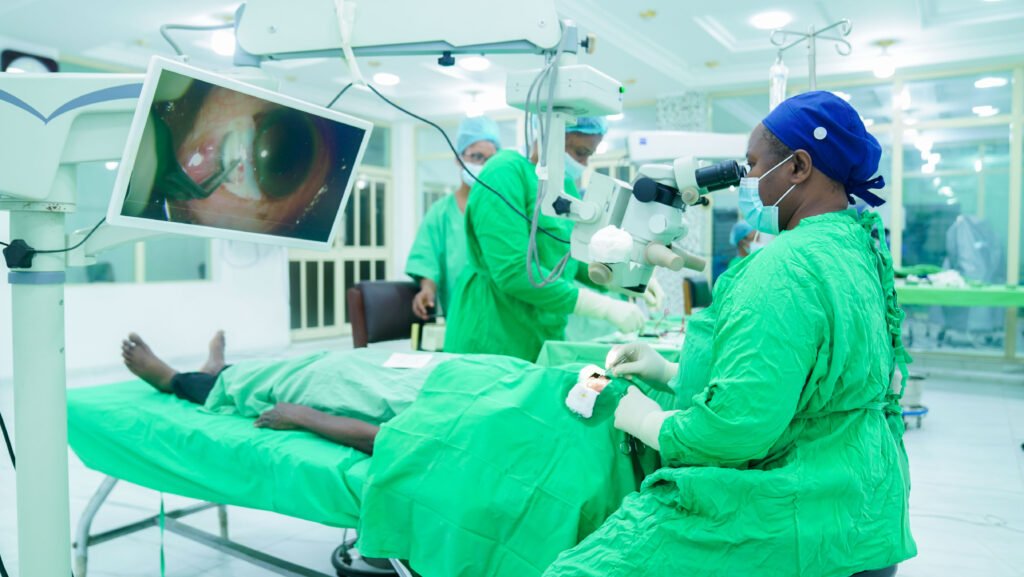
That last group matters more than the numbers suggest. A visiting vitreo-retinal consultant means retinal surgery can be done here rather than referred hundreds of kilometres away. A visiting paediatric consultant means a child with congenital cataract can be operated on inside the window in which their sight can still develop. A visiting anaesthetist means the theatre can safely take patients, children included, who need general anaesthesia.
Alongside the theatre and the clinics the hospital now runs a laser suite, an investigation unit with OCT, perimetry, biometry and ocular ultrasound, and an optical workshop where lenses are edged and fitted on site. Beyond the gate, community outreach and school screening programmes take eye care to people who would never otherwise reach a hospital.
OUR PURPOSE
Our mission and our vision
The mission of the hospital is to witness to our patients the humble service of Christ by providing excellent and merciful care.
Its vision is to eliminate avoidable blindness through the provision of equitable access to quality, comprehensive, affordable and inclusive eye health services.
Where to find us
The hospital is located at Mgbirichi, in Ohaji/Egbema Local Government Area of Imo State, about 18 kilometres from Owerri, the state capital.
It is reached from the Owerri to Port Harcourt Expressway. Owerri itself is easily reached from the neighbouring cities of Umuahia, Okigwe, Aba, Onitsha, Yenagoa and Port Harcourt, which places the hospital within a manageable journey for patients across the South East and South South.
The choice of site was deliberate. Mgbirichi is rural, and building there rather than in a city put the hospital within reach of the communities in which avoidable blindness is most common and specialist eye care hardest to find.
Come and see us
St Joseph’s Eye Hospital Mgbirichi, Ohaji/Egbema LGA, Imo State. Clinics run Mondays to Fridays, 7am to 5pm.
Emergency line: (+234) 706 313 0156