Medical Eye Services in Imo State
Our medical clinic manages eye disease that is treated with medication, monitoring and care rather than an operation. Most patients who come to St Joseph’s Eye Hospital Mgbirichi are seen here first, and many need nothing more.
WHAT WE TREAT
What our medical clinic covers
Our ophthalmologists diagnose and manage the full range of eye disease.
Styes and chalazia, inflammation of the lid margin, lids that turn inwards or outwards, drooping lids and growths on the lid.
Conjunctivitis of every kind, allergic eye disease, pterygium, and dryness of the surface of the eye.
Ulcers and infections, scarring, and the corneal damage that follows injury, chemical splash or long-standing dryness.
Diagnosis, pressure-lowering drops, monitoring of the optic nerve and visual field over time, and referral for laser or surgery where drops are not enough.
Cataract assessed and staged, and lens problems that follow injury, inflammation or other eye disease.
Uveitis and other inflammation inside the eye, which is often the first sign of a condition elsewhere in the body.
Assessment and medical treatment of blunt injury, foreign bodies, chemical splash and burns to the eye and lids.
Swelling, infection and growths in the socket around and behind the eye, including thyroid eye disease.
Diabetic retinopathy, hypertensive changes, macular disease and blockage of the retinal veins.
Assessment of growths on and inside the eye, including retinoblastoma in children, which is urgent.
The eye complications of diabetes, high blood pressure, sickle cell disease and other general illness.
What happens at your visit
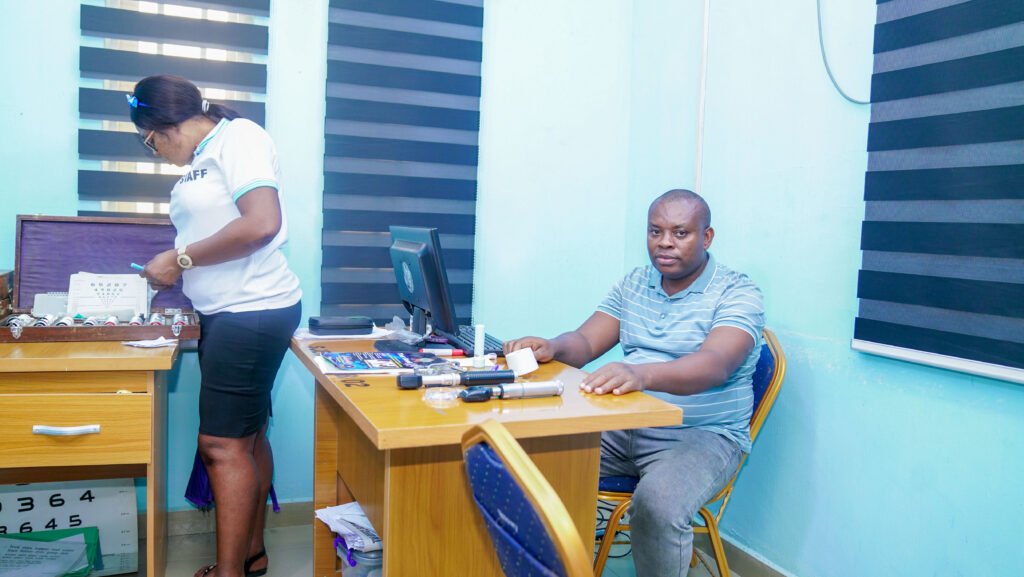
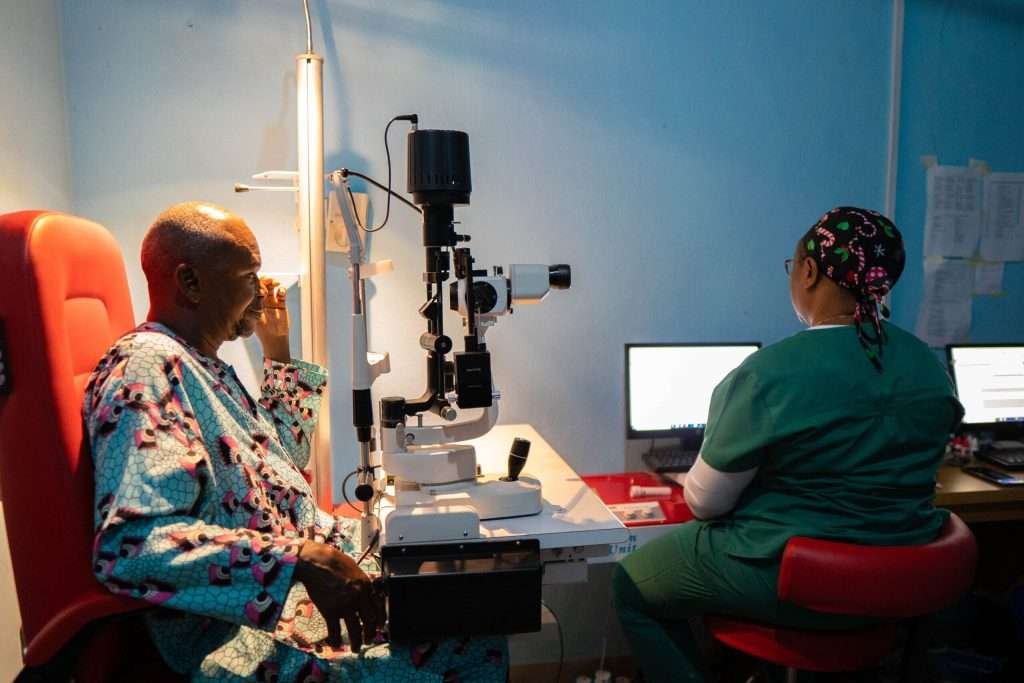
Your visit begins with a check of your vision, followed by an examination of the front of the eye on the slit lamp and a measurement of the pressure inside the eye. Where the retina needs to be seen, drops are used to widen the pupil. These blur your vision for a few hours, so it is best to bring someone with you and not to drive yourself home.
Where a condition needs surgery, laser or further investigation, you are referred on within the hospital rather than sent elsewhere. Our surgical, laser, optical and investigation units all sit on the same site, so your care does not stop at the clinic door.
Bring any spectacles you wear, any eye drops or tablets you are using, and any letters or results from other hospitals. If you are diabetic or hypertensive, tell us, because it changes what we look for.
The conditions we see most often
The commonest reasons people come to our medical clinic are cataract, glaucoma, refractive error and infections of the front of the eye. Cataract and refractive error are the most treatable causes of poor sight in our region, and both are often left far too long.
Glaucoma is different, and it is the one we most want to find early. It damages sight silently from the edges inwards, and what is lost cannot be brought back, but what remains can almost always be protected once treatment starts. If you are over 40, or anyone in your family has glaucoma, ask for your pressures and optic nerves to be checked even if your sight feels perfect.
Systemic ophthalmology
Many general health conditions show themselves in the eye, diabetes and high blood pressure above all. Diabetes damages the small vessels of the retina long before vision changes, which is why everyone living with diabetes needs a dilated retinal examination every year, whether or not they have noticed a problem.
Our medical clinic looks at the eye in the context of your general health, and works alongside your physician or diabetes doctor where that matters. Good control of blood sugar, blood pressure and cholesterol protects sight more effectively than anything we can do in the clinic afterwards.
Long-term care and follow-up
Several eye conditions are managed rather than cured. Glaucoma above all, but also diabetic eye disease and chronic disease of the ocular surface, need drops taken every day and reviews for the rest of a person’s life. That is not a failure of treatment; it is how these conditions work.
Our clinic keeps a record of your pressures, visual fields and optic nerves over time, because it is the comparison between visits, and not any single visit, that tells us whether a condition is stable or progressing.
When to come without waiting
Some things should not wait for a routine appointment. Come the same day if you have sudden loss of vision in one eye, a sudden shower of floaters or flashing lights, a curtain or shadow across your sight, a painful red eye with light sensitivity, or any injury to the eye.
For a child, a white or grey reflection in the pupil, often first spotted in a flash photograph, needs urgent examination.
Our emergency line is (+234) 706 313 0156.
Book an appointment
Come and see our eye care team at St Joseph’s Eye Hospital Mgbirichi. We see patients from across Imo State and the South East.